
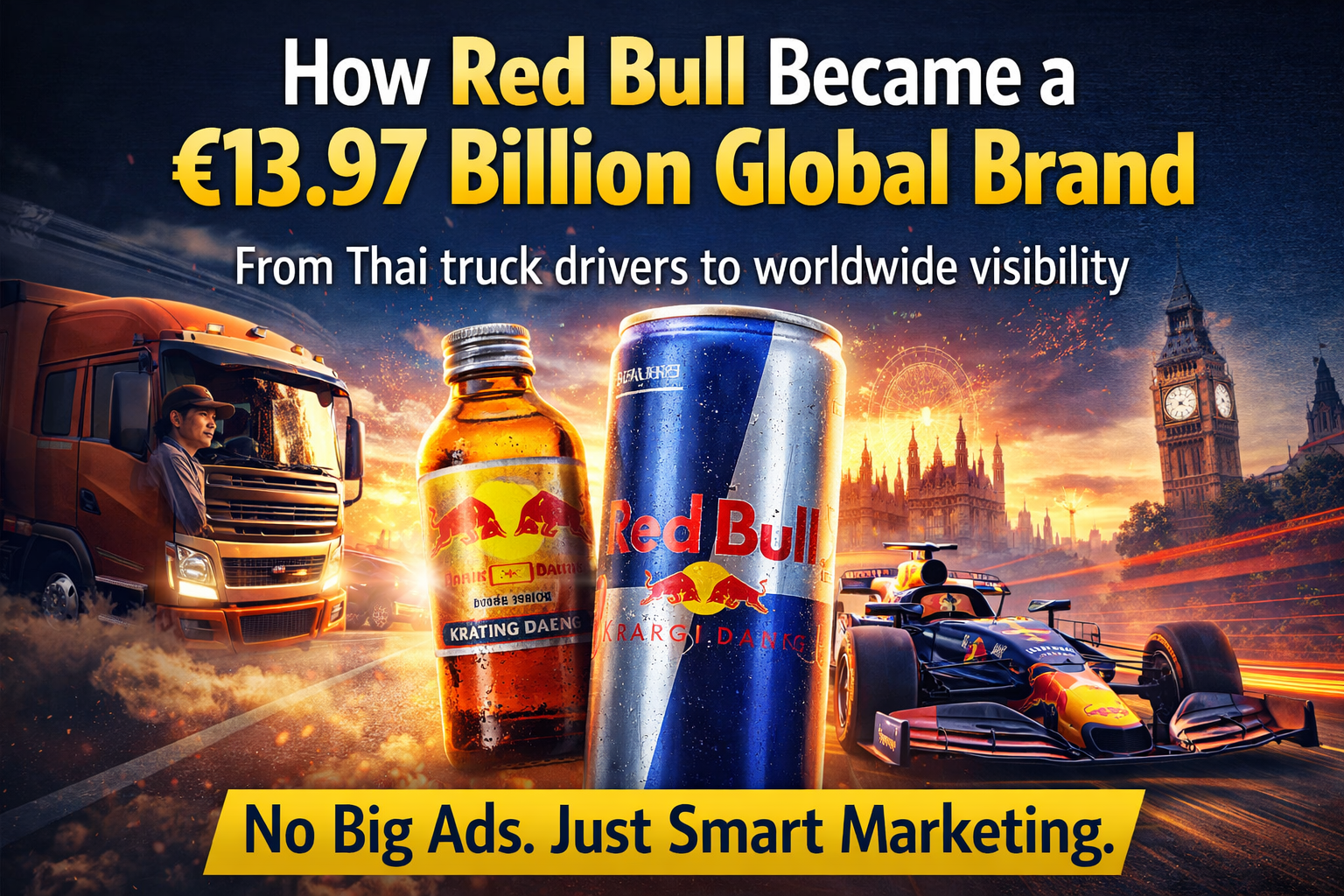
How Red Bull Became a $13.97 Billion Brand Without Traditional Advertising
Introduction
What if I told you one of the world’s biggest brands didn’t grow through ads… But through perception?
Today, Red Bull generates over €13.97 billion in revenue and sells billions of cans globally.
But it didn’t start that way.
It started as a small energy tonic for Thai truck drivers.
This is the story of how Red Bull used smart marketing, social proof, and brand visibility to become a global powerhouse—and what you can learn from it.
The Origin: From Thailand to a Global Brand
Back in 1982, Dietrich Mateschitz discovered a local Thai drink called Krating Daeng during a business trip.
Instead of just consuming it, he saw potential.
He partnered with Chaleo Yoovidhya and launched Red Bull in Austria in 1987.
But here’s where things get interesting…
They didn’t rely on traditional marketing.
They built something much more powerful: a cultural brand.
The Breakthrough: Entering the UK Market Without Ads
When Red Bull entered the UK in 1994, they didn’t spend heavily on advertising.
Instead, they focused on one thing:
👉 Making the brand impossible to ignore
Here’s what they did:
Gave free cans to DJs in London clubs
Turned bartenders into brand promoters
Distributed branded merchandise in nightlife scenes
But the smartest move?
👉 They left empty Red Bull cans on tables and near club bins.
The Psychology: Creating Demand Before It Exists
This strategy tapped into a powerful concept:
👉 Social Proof
When people repeatedly see a product:
They assume it’s popular
They trust it more
They feel curious to try it
Red Bull didn’t wait for demand.
They created the illusion of demand first.
And that changed everything.
Owning Culture Instead of Renting Attention
Most brands try to “advertise.”
Red Bull chose to own culture.
They moved beyond nightlife and entered the world of extreme sports and adrenaline.
Today, Red Bull is deeply associated with:
Adventure
Performance
Energy
One of the biggest examples?
👉 Red Bull Racing in Formula One.
This isn’t just sponsorship.
This is brand integration at scale.
Millions of viewers see the brand—not as an ad—but as part of the experience.
The Result: A Global Marketing Machine
Today, Red Bull:
Operates in 170+ countries
Sells billions of cans annually
Generates €13.97 billion in revenue
All built on one core principle:
Visibility creates credibility
What Most D2C Brands Get Wrong
Many brands today—especially in India—make one critical mistake:
They spend crores on ads before building recognition.
But here’s the truth:
People don’t buy what they don’t recognize
Red Bull didn’t start with reach.
They started with presence.
Key Marketing Lessons You Can Apply
1. Visibility Beats Virality
Don’t chase viral moments—focus on being seen consistently.
2. Create Social Proof
Make your brand appear popular before it becomes popular.
3. Be Where Your Audience Is
Red Bull didn’t guess—they went directly into nightlife culture.
4. Build a Lifestyle, Not Just a Product
People don’t just buy drinks—they buy identity.
Conclusion
Sometimes, the smartest marketing doesn’t feel like marketing at all.
It feels natural.
It feels everywhere.
It feels trusted.
That’s exactly what Red Bull mastered.
At Insightful Hub, we help brands build visibility, positioning, and marketing strategies that actually work in the real world—not just on paper.
If you want your brand to stand out (without burning money on ads), it’s time to think differently.