
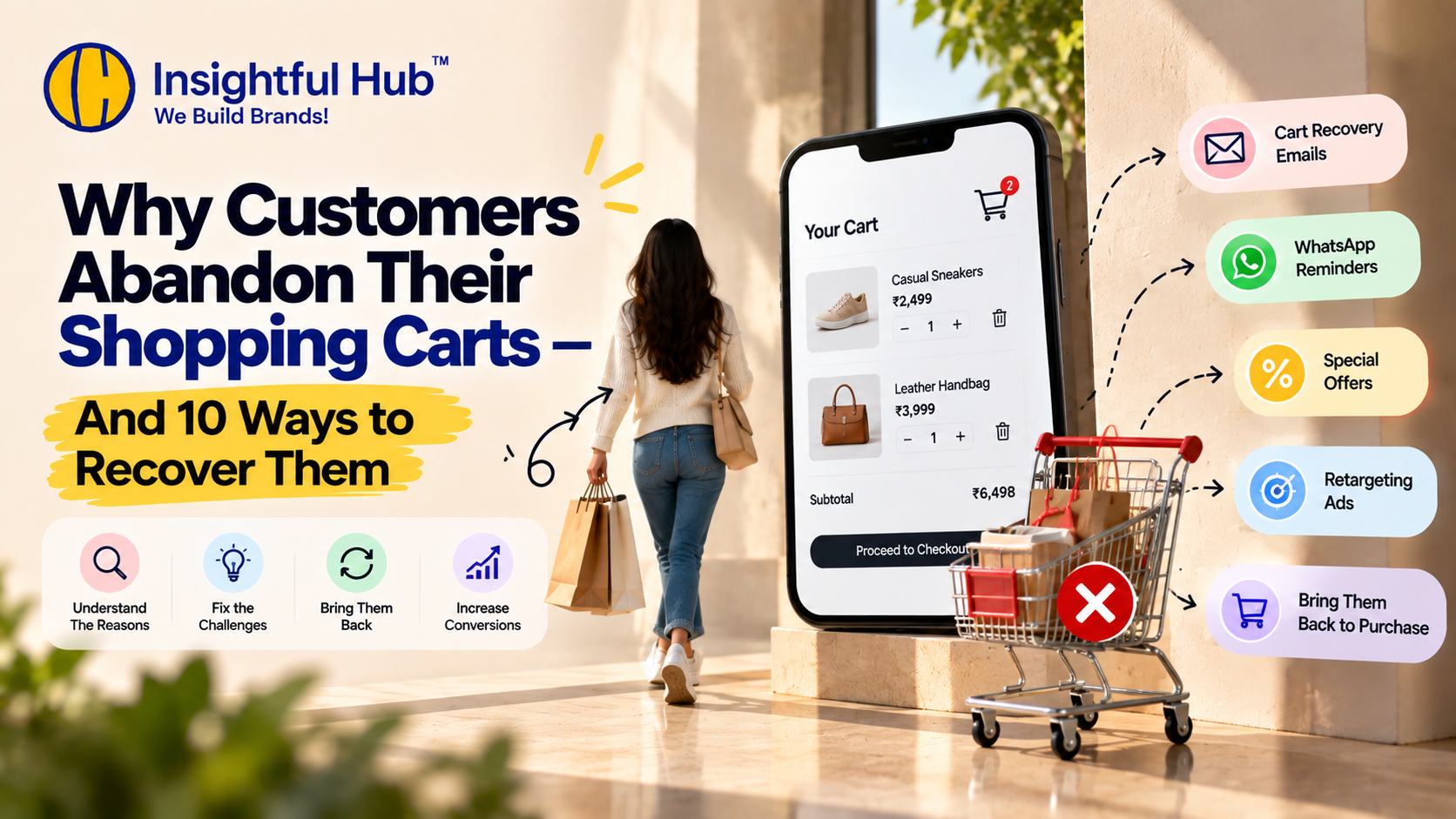
Why Customers Abandon Their Shopping Carts — And 10 Ways to Recover Them
Getting customers to add products to their shopping cart is a major step for any ecommerce or D2C brand. But adding a product to the cart doesn’t always lead to a purchase.
Customers may leave because of unexpected costs, complicated checkout processes, lack of trust, slow websites, or simply because they aren’t ready to buy yet.
For D2C brands, cart abandonment recovery can be an important part of improving ecommerce conversions without relying entirely on acquiring new customers.
Here are some of the most common reasons customers abandon carts — along with 10 practical ways to bring them back.
Why Do Customers Abandon Their Shopping Carts?
Cart abandonment can happen for many reasons.
Some customers leave because of a problem with the checkout experience, while others simply need more time before making a decision.
Common reasons include:
- Unexpected shipping charges
- Complicated checkout
- Slow website performance
- Limited payment options
- Lack of trust
- Unclear return policies
- High product prices
- Comparison shopping
- Distractions
- Customers not being ready to purchase

Understanding why customers abandon carts is the first step toward recovering those potential sales.
1. Make All Costs Clear Before Checkout
Unexpected costs can create hesitation.
Customers should be able to understand the total cost of their order before reaching the final payment stage.
Clearly communicate:
- Product price
- Shipping charges
- Taxes where applicable
- Discounts
- Final order total
Avoid surprising customers with additional charges at the last step.
2. Simplify Your Checkout Process
A complicated checkout can turn a ready-to-buy customer into an abandoned cart.
Keep your checkout as simple as possible.
Reduce unnecessary fields and make important information easy to understand.
A smooth journey should look like:
Cart → Customer Details → Payment → Order Confirmation
The fewer unnecessary steps, the easier it is for customers to complete their purchase.
3. Offer Multiple Payment Options
Customers have different payment preferences.
Depending on your target market, consider offering options such as:
- UPI
- Credit and debit cards
- Net banking
- Digital wallets
- Cash on delivery where appropriate
- Buy Now, Pay Later where suitable
Giving customers familiar payment methods can reduce friction at checkout.
Keyword Focus:
- ecommerce checkout optimization
- shopping cart abandonment
- ecommerce conversion optimization
- D2C conversion rate
4. Build Trust Before Asking Customers to Pay
Customers may hesitate if they aren’t confident about the brand.
Add relevant trust signals throughout the buying journey, such as:
- Customer reviews
- Ratings
- Testimonials
- Secure payment information
- Return policy
- Shipping information
- Customer support details
- Product guarantees where applicable

Trust is especially important for newer D2C brands that customers may not be familiar with.
10 Ways to Recover Abandoned Carts
1. Send Abandoned Cart Emails
A simple reminder can bring customers back to their unfinished purchase.
Instead of sending only:
“You left something in your cart.”
make the message useful by including:
- Product image
- Product name
- Cart price
- Checkout link
- Key benefit
- Support information
2. Use WhatsApp Cart Recovery
For brands where WhatsApp is an appropriate customer communication channel, abandoned-cart reminders can provide another way to reconnect with potential buyers.
A short message could remind customers about their cart and provide a direct link to complete the purchase.
Keep the communication helpful rather than sending repeated messages.
Keyword Focus:
- WhatsApp marketing for ecommerce
- abandoned cart recovery
- D2C WhatsApp marketing
- ecommerce retention marketing
3. Use Retargeting Ads
Customers who abandon their carts can potentially be reached again through retargeting campaigns.
You can show relevant ads featuring:
- The product they viewed
- The product they added to cart
- Customer reviews
- Product benefits
- Relevant offers
The goal is to bring interested customers back to the product rather than repeatedly showing them generic advertisements.
4. Give Customers a Reason to Complete the Purchase
Some customers need an additional incentive.
Depending on your business model, you could test:
- Free shipping
- Limited-time offers
- Product bundles
- Free gifts
- First-order incentives
- Loyalty rewards
However, avoid training customers to abandon carts simply to wait for discounts.
Your recovery strategy should not always depend on price reductions.
5. Improve Your Mobile Checkout
Many ecommerce journeys begin on smartphones.
Test your entire checkout process on mobile.
Check:
- Button sizes
- Page speed
- Form fields
- Product information
- Payment options
- Coupon functionality
- Error messages
- Navigation

A checkout that works well on desktop can still create problems on mobile.
6. Show Clear Delivery Information
Customers may abandon their carts if they don’t know when their order will arrive.
Make delivery information easy to find.
Where possible, communicate:
Estimated delivery date → Shipping cost → Delivery location
Clear expectations can reduce uncertainty before payment.
7. Make Returns and Refunds Easy to Understand
Customers may hesitate when they don’t know what happens if the product isn’t right for them.
Clearly communicate:
- Return eligibility
- Return period
- Refund process
- Exchange options
- Customer support process
Don’t make customers search through multiple pages to find this information.
8. Use Social Proof in Recovery Campaigns
Sometimes customers simply need reassurance.
You can include relevant social proof in your recovery emails, landing pages, or retargeting campaigns.
For example:
- Customer reviews
- Ratings
- UGC
- Testimonials
- Product popularity
- Creator demonstrations
This can help address hesitation without relying entirely on discounts.
9. Recover Customers at the Right Time
Sending a reminder immediately after abandonment isn’t always the only approach.
Depending on your product and buying cycle, you can test different recovery timings.
For example:
First reminder: Helpful cart reminder
Second reminder: Product benefits or reviews
Later reminder: Relevant incentive, if appropriate
The ideal timing can vary significantly between businesses, so measure your results rather than assuming one timing works for everyone.
10. Analyze Why Customers Are Leaving
The most important recovery strategy is understanding why customers abandon their carts in the first place.
Monitor metrics such as:
- Add-to-cart rate
- Checkout initiation rate
- Checkout completion rate
- Cart abandonment rate
- Payment failure rate
- Conversion rate
- Average order value
Look for patterns.
If many customers add products to their cart but leave after seeing shipping costs, investigate your shipping strategy.
If customers reach payment but don’t complete the order, investigate the checkout and payment experience.
A Simple Cart Recovery Funnel
A strong recovery strategy can look like:
Product View
↓
Add to Cart
↓
Checkout
↓
Cart Abandoned
↓
Email / WhatsApp Reminder
↓
Retargeting
↓
Return to Checkout
↓
Purchase
↓
Post-Purchase Retention
This turns cart recovery into part of a larger D2C customer journey rather than treating it as a single reminder message.
How D2C Brands Can Reduce Cart Abandonment
Instead of focusing only on recovering abandoned carts, brands should also work on preventing abandonment.
Focus on:
- Transparent pricing
- Fast website performance
- Simple checkout
- Multiple payment options
- Strong product information
- Customer reviews
- Clear shipping policies
- Easy returns
- Mobile optimization
- Reliable customer support
The best cart recovery strategy is a combination of better customer experience + smart follow-up.
The Future of Cart Recovery
As ecommerce becomes more personalized, brands are moving beyond generic abandoned-cart emails.
D2C brands can increasingly use:
- Personalized product recommendations
- AI-assisted customer journeys
- WhatsApp automation
- Dynamic retargeting
- First-party customer data
- Personalized offers
- Post-purchase automation
- Customer segmentation
The focus is shifting from simply reminding customers about their carts to understanding why they didn’t purchase and what information they need next.
Final Thoughts
Shopping cart abandonment doesn’t always mean a customer has lost interest.
Sometimes they need more information. Sometimes the checkout is creating friction. And sometimes they simply aren’t ready to buy yet.
D2C brands can recover more opportunities by combining:
Simple Checkout + Trust + Clear Pricing + Retargeting + Personalized Follow-Up
The goal isn’t to convince every abandoned-cart customer to purchase.
It’s to remove unnecessary friction and create a better buying experience for customers who are already interested in your products.