
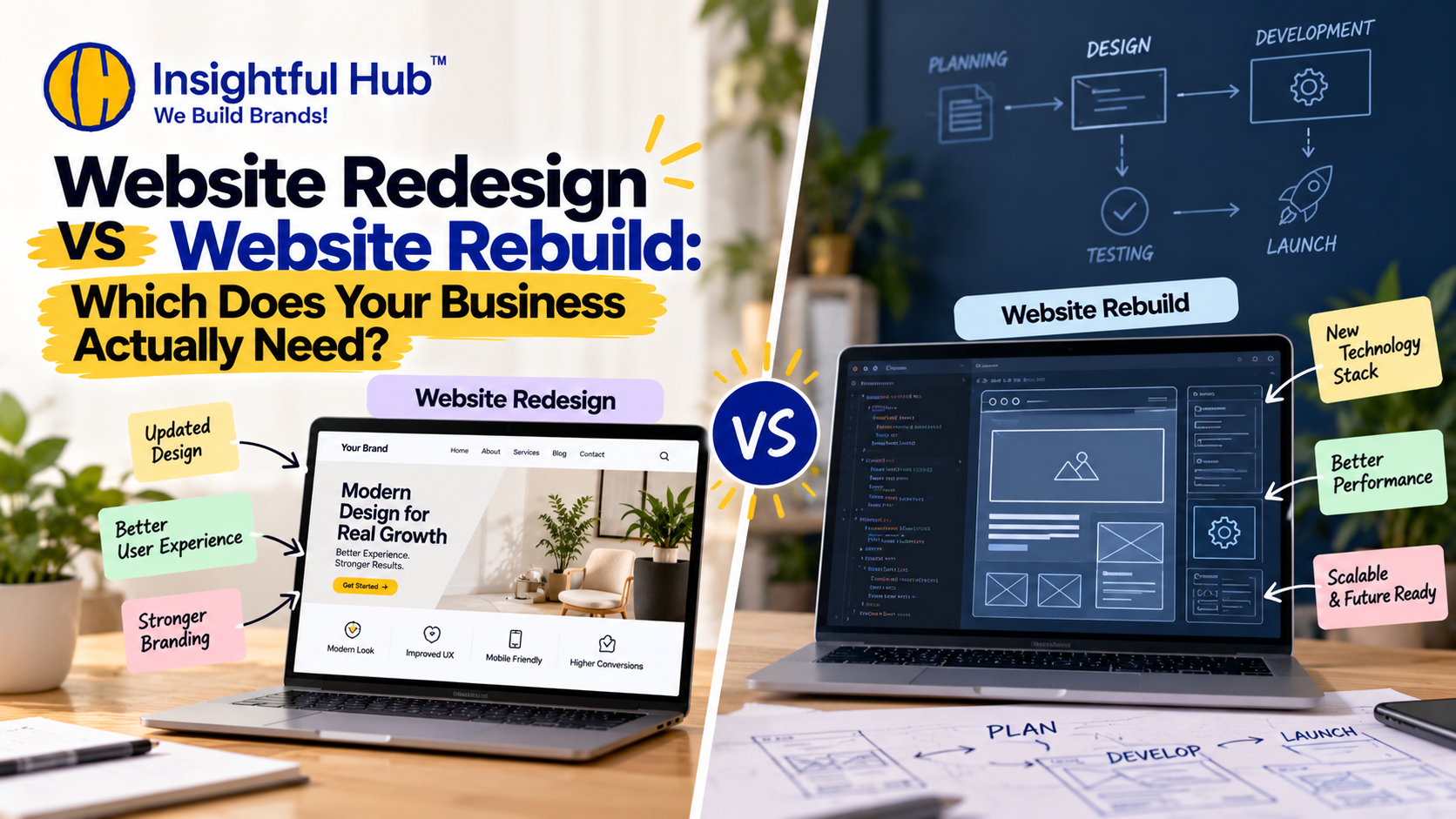
Website Redesign vs Website Rebuild: Which Does Your Business Actually Need?
Your website is often the first impression customers have of your business. But what happens when it looks outdated, loads slowly, or fails to generate enquiries and sales?
You might be wondering whether to redesign your existing website or rebuild it from scratch. Although both approaches can improve your online presence, the right choice depends on your website’s current condition, technical limitations, and business goals.
In this guide, we explain the difference between a website redesign and a website rebuild to help you make the right decision.
What Is a Website Redesign?
A website redesign focuses on improving the appearance, layout, user experience, and content of your existing website while retaining most of its underlying structure and functionality.
When should you redesign your website?
Common signs
Your website looks outdated but works properly.
Your branding, colours, or typography need improvement.
Navigation is confusing for visitors.
Your website needs better mobile responsiveness.
Your existing pages need improved calls to action.
A redesign is often suitable when your website’s foundation is reliable but its appearance or user experience needs improvement.
What Is a Website Rebuild?
A website rebuild involves developing your website again, often with a new technical structure, platform, or architecture. It may include migrating content, replacing outdated functionality, and improving performance.
When should you rebuild your website?
Common signs
Your website has serious technical or performance issues.
Your current platform limits essential features.
Maintaining the existing code has become difficult.
Your website cannot support your business’s growing requirements.
Integrations, security, or scalability require major changes.
A rebuild may require more time and investment, but it can provide a stronger foundation for future growth.
Website Redesign vs Website Rebuild: Key Differences
| Factor | Website Redesign | Website Rebuild |
|---|---|---|
| Main focus | Visuals and user experience | Structure and functionality |
| Existing code | Mostly retained | Often replaced |
| Cost | Usually lower | Usually higher |
| Time required | Generally shorter | Generally longer |
| Best for | Improving an existing website | Fixing deeper technical limitations |
Actual cost and timelines depend on the website’s size, complexity, and requirements.
How to Decide Which Option Your Business Needs
Choose a redesign if your website works but underperforms
Focus on improvements
If your website functions well but looks outdated or struggles to convert visitors, improve its design, navigation, content, mobile experience, and conversion paths.
Choose a rebuild if your website has deeper problems
Focus on the foundation
If technical limitations prevent you from improving performance, adding important features, or maintaining the website efficiently, a rebuild may be the better long-term investment.
Evaluate your business goals first
Ask these questions
Does my current website support my business goals?
Are the problems mainly visual or technical?
Can the existing platform support future requirements?
Will targeted improvements solve the main issues?
Your answers will help you avoid spending money on changes that do not address the real problem.
How Insightful Hub Can Help
At Insightful Hub, we help businesses strengthen their digital presence through website strategy, design, development, and performance-focused improvements.
Whether your business needs a refreshed design or a completely new website, the goal should be to create an experience that communicates your value, serves your customers, and supports measurable business objectives.
Explore our Web Design & Development services or contact our team to discuss your website requirements.
Final Thoughts
A website redesign is ideal when your existing foundation works well but needs a better appearance or user experience. A website rebuild is more appropriate when technical limitations or structural problems prevent your business from moving forward.
The best decision is not necessarily the most expensive one. It is the one that solves your website’s actual problems and supports your future goals.