
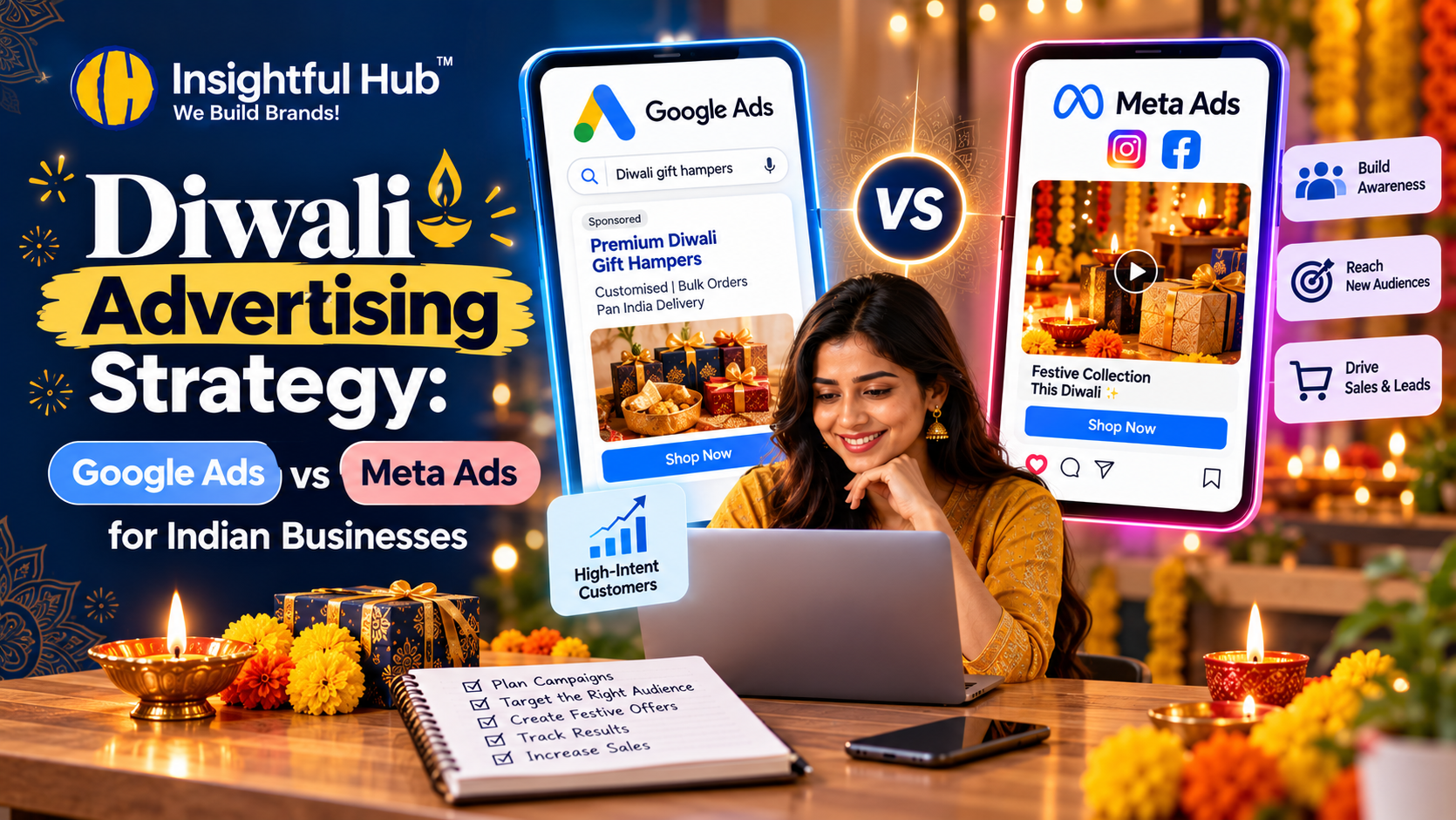
Diwali Advertising Strategy: Google Ads vs Meta Ads for Indian Businesses
Diwali is one of the most important sales opportunities for Indian businesses. From ecommerce brands and retail stores to restaurants, salons, real estate companies and service providers, businesses compete for customer attention during the festive season.
But when advertising budgets are limited, one question becomes important: Should you invest in Google Ads or Meta Ads for Diwali 2026?
Google Ads can help your business reach people actively searching for products and services, while Meta Ads—on Facebook and Instagram—can introduce your brand to potential customers through engaging videos, images and offers. Both platforms can support festive campaigns, but they serve different purposes.
Google’s September 2026 festive-shopping research highlights that Indian shoppers use multiple online touchpoints to discover and research products. It also reports that many shoppers who discover brands on Instagram or Facebook subsequently use Google Search to research them further. This makes a coordinated advertising strategy worth considering. Read Google’s festive advertising insights.
In this guide, we compare Google Ads vs Meta Ads for Indian businesses, explain when to use each platform, explore budget-planning examples and share a practical Diwali advertising strategy for 2026.
Google Ads vs Meta Ads: What Is the Difference?
Before choosing a platform, understand how each one connects your business with potential customers.
What Are Google Ads?
Google Ads allows businesses to advertise across Google Search and other Google advertising channels, depending on the campaign type.
For example, a customer searching for “Diwali gift hampers in Bengaluru” may see a relevant search advertisement from a gift company. This gives the business an opportunity to reach someone who is already looking for a solution.
Google Ads can be useful for:
Businesses selling products that customers actively search for.
Local businesses looking for calls, enquiries or store visits.
Companies offering services such as web design, digital marketing or event planning.
Ecommerce stores targeting product-specific searches.
Businesses looking to capture existing demand during the festive season.
Google offers several campaign types, including Search, Shopping and Performance Max, with the appropriate choice depending on your goals and available setup. See Google’s guide to choosing a campaign type.
What Are Meta Ads?
Meta Ads allows businesses to advertise across platforms such as Facebook and Instagram. Depending on the campaign setup, advertisements can appear in feeds, Stories, Reels and other placements.
Unlike a search advertisement that responds to a customer’s query, a Meta advertisement can introduce a product or offer to someone who was not actively looking for it.
For example, a boutique could show a festive collection video to a relevant audience, encouraging viewers to explore the products or enquire through WhatsApp.
Meta Ads can be useful for:
Fashion, beauty, food and lifestyle brands.
Ecommerce businesses with visually appealing products.
Businesses launching a new festive collection or offer.
Local brands looking to generate enquiries or bookings.
Companies building awareness and reconnecting with interested audiences.
The key is to select the campaign objective that matches your business goal and use creatives that clearly communicate your offer.
Google Ads vs Meta Ads for Diwali 2026: A Quick Comparison
| Factor | Google Ads | Meta Ads |
|---|---|---|
| Primary strength | Capturing existing search demand | Creating awareness and interest |
| How customers discover you | Through searches and other Google placements | Through Facebook, Instagram and other eligible placements |
| Best creative formats | Search text ads, product listings, images and videos, depending on campaign type | Images, short videos, Reels-style creatives and carousels |
| Audience approach | Search intent, keywords, location and audience signals, depending on campaign type | Audience targeting, placements, engagement and available conversion signals |
| Common goals | Search-driven leads, calls, purchases and website visits | Awareness, engagement, leads, messages and purchases |
| Strong use case | A customer searching for a product or service | A customer discovering an offer while browsing social media |
| Important requirement | Relevant keywords, ad copy and landing pages | Strong creatives, a relevant audience and a clear call to action |
Neither platform is automatically better for every business. Your product, competition, audience, margins and campaign objective determine which channel is more suitable.

1. When Should Indian Businesses Choose Google Ads for Diwali?
Google Ads is particularly useful when customers already know what they want and are searching for it online.
Imagine that you sell corporate Diwali gift hampers. Potential customers may search for terms such as:
Corporate Diwali gifts in Bengaluru
Customised Diwali gift hampers
Diwali sweets delivery near me
Diwali decoration services
Digital marketing agency for festive campaigns
These searches can indicate demand for a particular product or service. A well-targeted Search campaign can help your business appear when relevant customers are looking.
Best Google Ads Campaign Ideas for Diwali
Search campaigns: Target relevant product and service searches. Organise keywords into tightly related groups and write advertisements that match the searcher’s needs.
Shopping campaigns: Suitable for eligible ecommerce businesses with a properly configured product feed. Product information, pricing and availability should be accurate.
Performance Max: Consider this goal-based campaign type when you want to reach customers across Google’s eligible advertising inventory and have suitable conversion tracking and creative assets.
Local campaigns through suitable campaign types: Businesses seeking calls, directions, local leads or store visits should configure location targeting and conversion goals appropriately.
Example: A Corporate Gifting Business
Suppose a business sells customised Diwali hampers to offices and companies.
Its Google Search advertisement could communicate:
Customised corporate Diwali gift hampers
Bulk ordering available
Personalisation options
Order enquiry deadline
A direct link to the corporate gifting page
This makes the advertisement relevant to the customer’s search and gives them a clear next step.
Advantages of Google Ads
Reaches people searching for specific products or services.
Can capture demand close to the purchasing decision.
Supports keyword and location-based targeting.
Allows businesses to measure conversions when tracking is configured correctly.
Can be effective for lead generation and product-specific searches.
Limitations of Google Ads
Popular festive keywords may attract strong competition.
Broad or irrelevant keywords can waste budget.
Businesses may struggle if customers do not actively search for their offering.
A poorly designed landing page can reduce the value of otherwise relevant traffic.
Best suited for: Businesses with clear customer search demand, specific offers and landing pages designed to generate enquiries or sales.
2. When Should Indian Businesses Choose Meta Ads for Diwali?
Meta Ads can be especially useful when your product or service benefits from visual presentation or when customers need inspiration before making a purchase.
Think about a clothing brand showcasing festive outfits, a bakery presenting gift boxes or a home décor company showing how its products transform a living space.
These businesses can use engaging visuals to create interest and encourage potential customers to explore their offers.
Best Meta Ads Ideas for Diwali
Instagram Reels and video advertisements: Demonstrate products, show festive preparations or highlight the benefits of a service.
Carousel advertisements: Showcase multiple products, gift bundles or packages in one advertisement.
Lead generation campaigns: Encourage interested customers to submit their details when the campaign is configured for lead generation.
Click-to-message campaigns: Where available and suitable, direct customers to a messaging conversation so they can ask questions or enquire about an offer.
Remarketing: Reach eligible audiences who have previously visited your website or engaged with your business, subject to available audience data and applicable privacy requirements.
Example: A Fashion Boutique
A boutique wants to promote its Diwali collection.
It could create short videos showing festive outfits, styling ideas and different price ranges. The advertisement could direct customers to a product collection or encourage them to enquire about sizes and availability.
The creative should answer three questions quickly:
What is being offered?
Why should the customer be interested?
What should the customer do next?
Advantages of Meta Ads
Strong visual formats for showcasing products and offers.
Can introduce your brand to potential customers who are not actively searching.
Supports awareness, lead generation, messages and sales objectives.
Offers opportunities to test different creative concepts.
Can help businesses reconnect with relevant audiences.
Limitations of Meta Ads
People browsing social media may not be ready to purchase immediately.
Creative fatigue can reduce performance when advertisements are repeated too often.
Weak offers or unclear messaging can generate attention without meaningful enquiries.
Sales and lead quality depend on targeting, the offer, the customer journey and follow-up.
Best suited for: Visually appealing products, new launches, festive offers, audience discovery and businesses that can create engaging content.

3. Google Ads vs Meta Ads: Which Is Better for Different Businesses?
The best platform depends on what your business sells and how customers typically discover it.
| Business type | Recommended starting point | Why |
|---|---|---|
| Corporate gifting | Google Ads | Buyers may actively search for suppliers and bulk orders |
| Fashion and apparel | Meta Ads, supported by Google where relevant | Visual content helps customers discover products |
| Bakery or festive sweets | Both, depending on demand | Social content creates interest while Search can capture local purchase intent |
| Salon or beauty services | Both, depending on location and demand | Search captures service enquiries; Meta showcases offers and results |
| Ecommerce gift store | Both, where budget permits | Search and product ads can capture demand; Meta can introduce products and remarket |
| Digital marketing agency | Google Ads for high-intent searches; Meta for awareness and lead generation | Businesses may search for agencies or discover services through content |
| New or unfamiliar product | Often Meta first, then test Google | Visual demonstrations can help customers understand the product before searching for it |
These are starting recommendations, not fixed rules. Review your own customers’ behaviour and campaign data before deciding how much to spend on each channel.
4. How Much Should You Spend on Diwali Advertising?
Your advertising budget should be based on your business goals, profit margins and the amount you can afford to spend to acquire a customer.
There is no single budget that guarantees results. A small local business may begin with a modest test, while an established ecommerce brand may need a larger budget to support its sales targets.
The following figures are illustrative planning examples, not industry benchmarks or promised results.
| Total test budget | Example approach | Main purpose |
|---|---|---|
| ₹5,000 | Focus on one platform or one clearly defined campaign | Test the offer and initial response |
| ₹15,000 | Allocate more to the strongest channel and a smaller amount to test the other | Compare lead quality or sales potential |
| ₹30,000 | Test both platforms with distinct objectives and reserve budget for the stronger performer | Gather more evidence before scaling |
Do not split a small budget across too many campaigns, audiences and advertisements. Excessive fragmentation can make it difficult to learn which activity is working.
How to Decide Your Budget
Before launching your advertisements, calculate:
Your average order value or expected revenue per customer.
Your gross margin after relevant product or service costs.
The maximum acquisition cost your business can sustain.
The conversion rate of your website or enquiry process.
The budget you can spend without putting essential business expenses at risk.
For lead-generation businesses, consider the proportion of enquiries that become paying customers. A cheap lead is not necessarily valuable if the person is not a good fit for your service.
For ecommerce businesses, compare advertising cost with the profit generated by the resulting orders, not revenue alone.
5. How to Create Diwali Ads That Attract Customers
Choosing the right platform is only part of the process. Your advertisement must also communicate a relevant offer to the right audience.
Create One Clear Festive Offer
Avoid vague messaging such as “Biggest Diwali Sale!” without explaining what customers receive.
Instead, use specific messaging such as:
“Explore our Diwali gift hampers for every budget.”
“Book your festive beauty package before the available slots fill.”
“Discover our Diwali collection and order online.”
“Planning corporate gifts? Request a customised bulk quote.”
Only advertise discounts, delivery dates, availability and benefits that your business can genuinely provide.
Match the Ad to the Landing Page
If your advertisement promotes corporate gifting, send users to a page about corporate gifting—not a generic homepage.
The destination should clearly display the offer, relevant details, pricing or enquiry options, and a simple next step.
For support with campaign-ready pages, explore Insightful Hub’s web design and development services.
Use the Right Creative Format
For Google Search, focus on relevant headlines, useful descriptions, appropriate keyword targeting and a clear call to action.
For Meta, test a small set of strong visual concepts, such as a product demonstration, a gift guide or a short customer-focused video. Make the offer easy to understand even when someone sees the advertisement briefly.
Test Before Increasing Spend
Monitor meaningful results and make adjustments based on evidence. Avoid changing multiple campaign settings at once without a reason, because it can make performance harder to evaluate.
6. Why Your Diwali Landing Page Matters
A click is not the final goal. The visitor must be able to take the next step easily.
A campaign can attract relevant traffic but still produce few sales or enquiries if the website is slow, confusing or difficult to use on a mobile device.
Before spending heavily, check that your landing page:
Loads quickly on mobile and desktop.
Clearly explains the product, service or festive offer.
Shows accurate prices, terms and availability.
Has a visible call-to-action button.
Makes phone, WhatsApp and enquiry options easy to find.
Uses trustworthy product images and business information.
Has functioning forms and checkout steps.
Includes conversion tracking that has been tested.
If customers need to ask questions before buying, make sure someone can respond to enquiries promptly during the campaign.
7. How to Track Google Ads and Meta Ads Performance
Do not measure your Diwali campaign only by impressions, likes or clicks. Track the actions that contribute to your business goals.
| Metric | What it tells you |
|---|---|
| Click-through rate | How often people click after seeing an advertisement |
| Cost per click | How much you pay, on average, for a click |
| Conversion rate | The proportion of visitors who complete the measured action |
| Cost per lead | The advertising cost associated with each tracked lead |
| Cost per purchase | The advertising cost associated with each tracked purchase |
| Return on ad spend (ROAS) | Tracked revenue divided by advertising spend |
| Lead-to-customer rate | How many leads become paying customers |
Set up Google Ads conversion tracking and suitable Meta tracking before launching campaigns. Depending on your website and sales process, this may involve Google Analytics 4, the Meta Pixel, server-side event integrations or CRM records.
Check that important events—such as purchases, calls or qualified lead submissions—are recorded correctly and not counted multiple times.
Remember that platform-reported results may use different attribution methods. Compare them with your actual orders, enquiries and revenue wherever possible.
For campaign management and measurement support, learn more about Insightful Hub’s performance marketing services.
8. Should You Run Google Ads and Meta Ads Together?
For many businesses, using both platforms can create a more complete customer journey.
A customer might first see a Diwali product video on Instagram, later search for the brand or product on Google, and finally purchase after reviewing the website.
This illustrates why judging each platform in isolation can sometimes miss part of the journey. Google’s 2026 festive-shopping insights also describe shoppers moving between social discovery and search-based research. Explore the research.
A coordinated campaign could work like this:
Introduce the offer: Use Meta creative to showcase the product or service to relevant audiences.
Capture active demand: Use Google Search campaigns for relevant, high-intent searches.
Reconnect with interested visitors: Use eligible remarketing audiences where tracking, consent and platform requirements are satisfied.
Convert enquiries: Direct people to a relevant landing page or a staffed messaging channel.
Measure the outcome: Compare purchases, qualified leads and acquisition costs with actual business results.
If your budget is limited, start with the platform most closely aligned with your immediate objective. Expand to the second platform when you have a clear reason and enough budget to measure its contribution.
9. A Practical Diwali Advertising Plan for 2026
Diwali falls on 8 November 2026, so businesses planning campaigns now have a short period to prepare. Prioritise the essentials rather than trying to build an overly complicated advertising structure at the last minute.
Step 1: Finalise the Offer
Choose the product, service or package you want to promote. Confirm the pricing, availability, terms and fulfilment capacity.
Step 2: Prepare Your Website and Tracking
Create or improve the relevant landing page. Test forms, calls, checkout and conversion events before increasing your budget.
Step 3: Launch a Focused Campaign
Choose the platform that best matches your customers’ behaviour. Use relevant search terms for Google Search or strong visual creatives for Meta.
Step 4: Monitor Quality and Costs
Review enquiries, sales, lead quality and advertising costs regularly. Do not keep spending on a campaign simply because it generates many clicks.
Step 5: Adjust Based on Evidence
Make measured changes to the offer, creative, audience or landing page when performance indicates a problem. Increase spend only when the results and fulfilment capacity justify it.
Step 6: Review After Diwali
Calculate the revenue and profit associated with your campaign where possible. Record what worked, what failed and what you should change for the next seasonal campaign.

How Insightful Hub Can Help With Your Diwali Advertising
Running effective advertising requires more than choosing Google Ads or Meta Ads. Businesses need a clear offer, the right audience, relevant creative assets, a well-designed landing page and accurate performance measurement.
Insightful Hub helps businesses improve their online presence through performance marketing and web design and development.
Whether you need help planning a festive campaign, generating relevant enquiries or improving the website visitors reach after clicking your ads, a structured strategy can help you make better use of your marketing budget.
Explore Insightful Hub’s performance marketing services, review our web design and development services, or contact our team to discuss your goals.
Frequently Asked Questions
1. Which is better for Diwali advertising: Google Ads or Meta Ads?
Google Ads is useful for reaching customers actively searching for products and services. Meta Ads is useful for creating interest through visual content and reaching relevant audiences while they browse. The best choice depends on your business, customer behaviour, campaign objective and budget.
2. Can a small business run Diwali ads with a low budget?
Yes. Start with a clear offer, one primary campaign objective and a focused audience. Test a manageable budget, track meaningful conversions and avoid spreading your spending across too many campaigns before you have evidence about what works.
3. Are Google Ads better for lead generation?
Google Search Ads can be effective when potential customers are actively searching for a service. However, Meta lead generation and messaging campaigns can also produce enquiries. Compare the quality and cost of leads—not just the number generated.
4. Are Meta Ads suitable for ecommerce businesses?
Yes. Meta Ads can help ecommerce brands showcase products, introduce new collections and reconnect with eligible audiences. Product quality, creative assets, pricing, the website experience and conversion tracking all influence performance.
5. Should I advertise on both platforms during Diwali?
Using both can help businesses reach customers during discovery and active search. However, it is not necessary for every business, especially when the available budget is small. Start with the channel that best matches your immediate goal and expand when you can measure the additional value.
6. How do I know whether my Diwali ads are profitable?
Compare the revenue and profit associated with your advertising against the cost of advertising and other relevant expenses. For lead generation, measure how many enquiries become paying customers and how much those customers contribute to profit. ROAS alone does not account for all business costs.
7. When should I start Google Ads and Meta Ads for Diwali?
Ideally, campaigns should be planned several weeks in advance so there is time to prepare offers, creative assets, landing pages and tracking. If the festive season is already close, focus on launching a well-prepared campaign quickly and avoid major untested changes during the busiest period.
Final Thoughts
Google Ads and Meta Ads are not competing solutions for every situation. They help businesses connect with customers in different ways.
Google Ads can capture existing demand when people search for a product or service. Meta Ads can create awareness and interest through engaging content. For businesses with suitable budgets and clear goals, combining the two may support a more complete customer journey.
Before investing this Diwali, clarify your offer, understand your audience, prepare your landing page and decide how you will measure success.
The best Diwali advertising strategy is not the one that generates the most clicks. It is the one that helps your business attract the right customers and turn advertising spend into measurable results.