
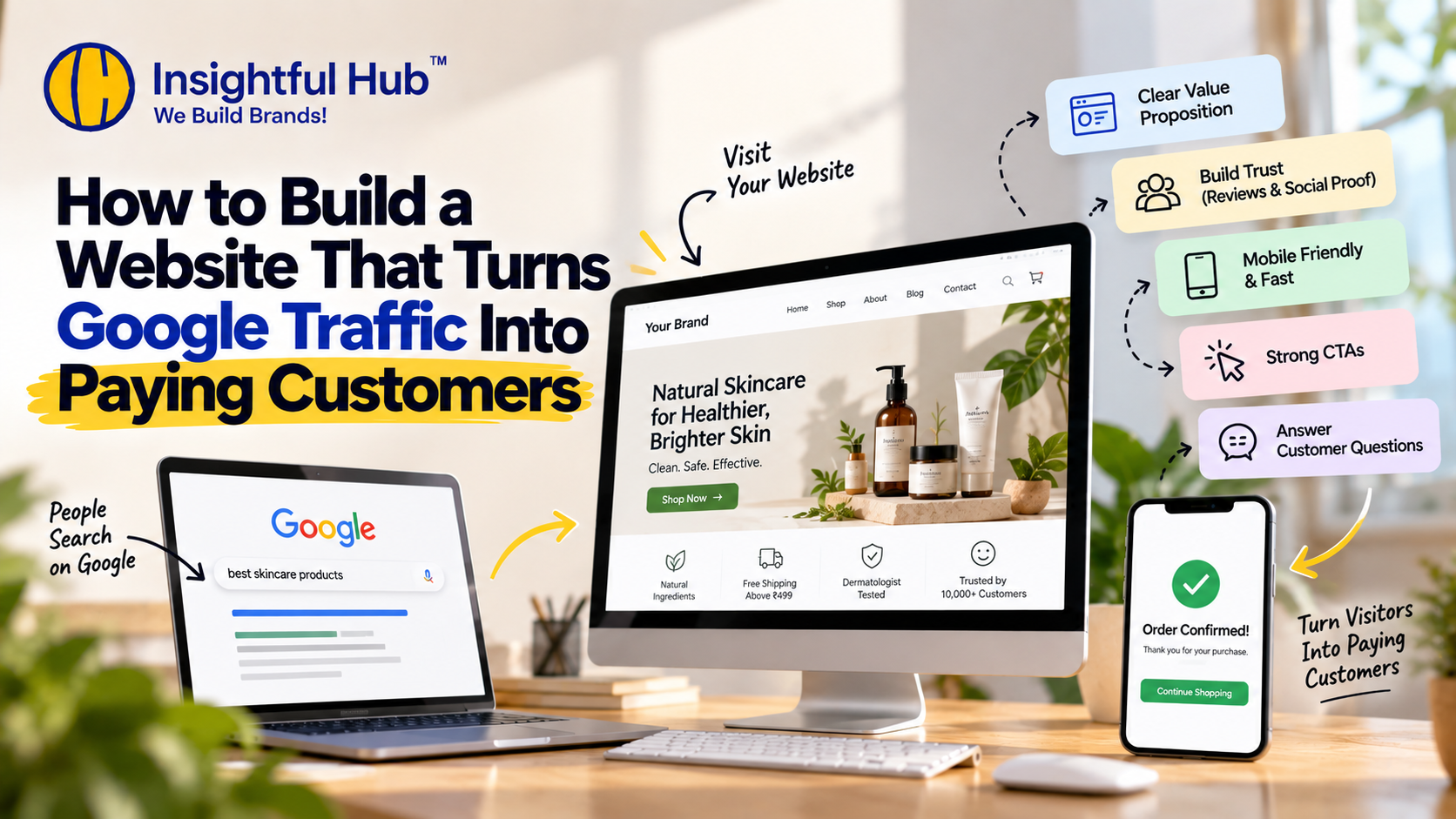
How to Build a Website That Turns Google Traffic Into Paying Customers
Ranking on Google can bring thousands of visitors to your website, but traffic alone doesn’t generate revenue.
Many businesses invest in SEO and successfully bring their website to Google’s search results, yet struggle to turn those visitors into leads or customers.
The difference is conversion-focused website design.
A website should not only attract visitors. It should quickly communicate your value, build trust, answer customer questions, and make the next action obvious.
Here are the key elements businesses should focus on when building a website that turns Google traffic into paying customers.
1. Match Your Website With Search Intent
Someone searching Google already has a reason for visiting your website.
For example:
- “Best website development company in Bangalore” → Looking for a service
- “How much does website development cost?” → Researching pricing
- “Buy running shoes online” → Ready to purchase
Your page should match the intent behind the search query.
If someone searches for a specific service but lands on a generic homepage, they may leave without taking action.
Create dedicated landing pages for important services, products, and search queries.

- SEO conversion optimization
- website conversion optimization
- SEO landing page
- convert website visitors into customers
2. Make Your Value Proposition Clear Immediately
When someone arrives from Google, they shouldn’t have to figure out what your business does.
Your hero section should quickly communicate:
What you offer → Who you help → Why you’re different → What to do next
For example, instead of:
“Welcome to Our Digital Agency”
you could communicate:
“Performance-Driven Digital Marketing for Growing D2C Brands.”
The second version gives visitors a much clearer reason to continue exploring.
3. Create Landing Pages for High-Intent Searches
One of the biggest opportunities in SEO is creating pages specifically for users who are already looking for your service or product.
For example, a digital agency could create dedicated pages for:
- SEO Services
- Website Development
- Shopify Development
- Performance Marketing
- Social Media Marketing
- D2C Marketing
Each page should be designed around the visitor’s specific needs instead of using the same generic content everywhere.
Keyword Focus:
- SEO landing pages
- service page optimization
- website lead generation
- SEO for business websites
4. Build Trust Before Asking for the Sale
Google visitors may be discovering your brand for the first time.
They need a reason to trust you.
Use relevant trust signals such as:
- Customer testimonials
- Reviews
- Case studies
- Client logos
- Portfolio examples
- Certifications
- Results and measurable outcomes
- FAQs
- Clear contact information
Don’t simply say that you’re the best.
Show visitors evidence that supports your claims.
5. Use Strong and Relevant CTAs
Every important page should guide visitors toward a logical next step.
Depending on your business, your CTA could be:
- Get a Free Consultation
- Request a Quote
- Book a Call
- Shop Now
- Get Started
- Download the Guide
- Contact Us
Avoid using the same CTA everywhere if the visitor’s intent is different.
A visitor reading an educational blog may need “Get the Complete Guide” or “Talk to an Expert”, while someone on a service page may be ready for “Request a Quote.”
6. Make Your Website Easy to Navigate
Visitors shouldn’t have to search through your website to find basic information.
Your navigation should make important pages easy to access.
A simple structure could be:
Home → Services → About → Case Studies → Blog → Contact
For ecommerce websites:
Home → Categories → Products → Cart → Checkout
Clear navigation helps visitors move naturally through your website instead of leaving because they can’t find what they need.
7. Optimize Your Website for Mobile
A website that looks excellent on desktop can still lose customers if the mobile experience is poor.
Check your website for:
- Page loading speed
- Readable text
- Easy navigation
- Large enough buttons
- Mobile-friendly forms
- Proper image sizing
- Sticky CTAs where appropriate
- Simple checkout
Your Google traffic shouldn’t have to fight through a difficult mobile experience to become a customer.
8. Make Your Website Fast
A slow website can create friction before visitors even see your offer.
Focus on:
- Compressing images
- Using modern image formats
- Reducing unnecessary scripts
- Optimizing CSS and JavaScript
- Improving server response time
- Using browser caching
- Optimizing mobile performance
Speed isn’t just a technical consideration.
It is part of the overall user experience.
9. Answer Customer Questions Before They Ask
Visitors often leave because they can’t find the information they need.
Use your website to address common questions about:
- Pricing
- Features
- Process
- Delivery
- Returns
- Timelines
- Support
- Compatibility
- Guarantees
A useful FAQ section can reduce uncertainty and help visitors move closer to taking action.
10. Measure What Happens After the Click
SEO traffic is only the beginning.
You should also understand what visitors do after arriving on your website.
Track metrics such as:
- Organic traffic
- Landing-page engagement
- Conversion rate
- Form submissions
- Phone calls
- Add-to-cart rate
- Checkout rate
- Sales
- Customer acquisition cost
For example:
10,000 Google visitors → 500 enquiries → 50 customers
is much more useful information than simply knowing you received 10,000 visitors.
How to Turn Google Traffic Into Customers
A simple conversion-focused website journey looks like:
Google Search
↓
Relevant Landing Page
↓
Clear Value Proposition
↓
Trust & Social Proof
↓
Useful Information
↓
Strong CTA
↓
Lead / Purchase
↓
Follow-Up
The important part is keeping the entire journey connected.
If your SEO strategy promises one thing but your landing page communicates something completely different, visitors may leave.
Common Website Conversion Mistakes
Focusing Only on Rankings
Getting to page one is valuable, but rankings don’t guarantee leads or sales.
Sending All Traffic to the Homepage
Specific search queries often deserve specific landing pages.
Using Generic CTAs
“Click Here” doesn’t communicate much. Use action-oriented CTAs that explain what happens next.
Ignoring Mobile Users
A poor mobile experience can create unnecessary friction.
Not Tracking Conversions
Without conversion tracking, you can’t easily determine which pages and channels contribute to business results.
The Future of SEO and Website Conversion
SEO is increasingly connected with the overall customer experience.
Businesses will need to focus on:
- Helpful content
- Strong user experience
- Fast websites
- Search intent
- Structured content
- Personalized experiences
- Conversion optimization
- First-party customer data
- AI-assisted search experiences
The goal is moving beyond “How do I get more Google traffic?”
The better question is:
“How do I turn relevant Google traffic into meaningful business results?”
Final Thoughts
SEO can bring potential customers to your website, but your website has to convince them to stay and take action.
A high-converting website combines:
Search Intent + Clear Messaging + Trust + UX + Speed + Strong CTAs + Conversion Tracking
Don’t build a website simply to rank on Google.
Build one that gives Google visitors a clear reason to stay, trust, and take the next step.