
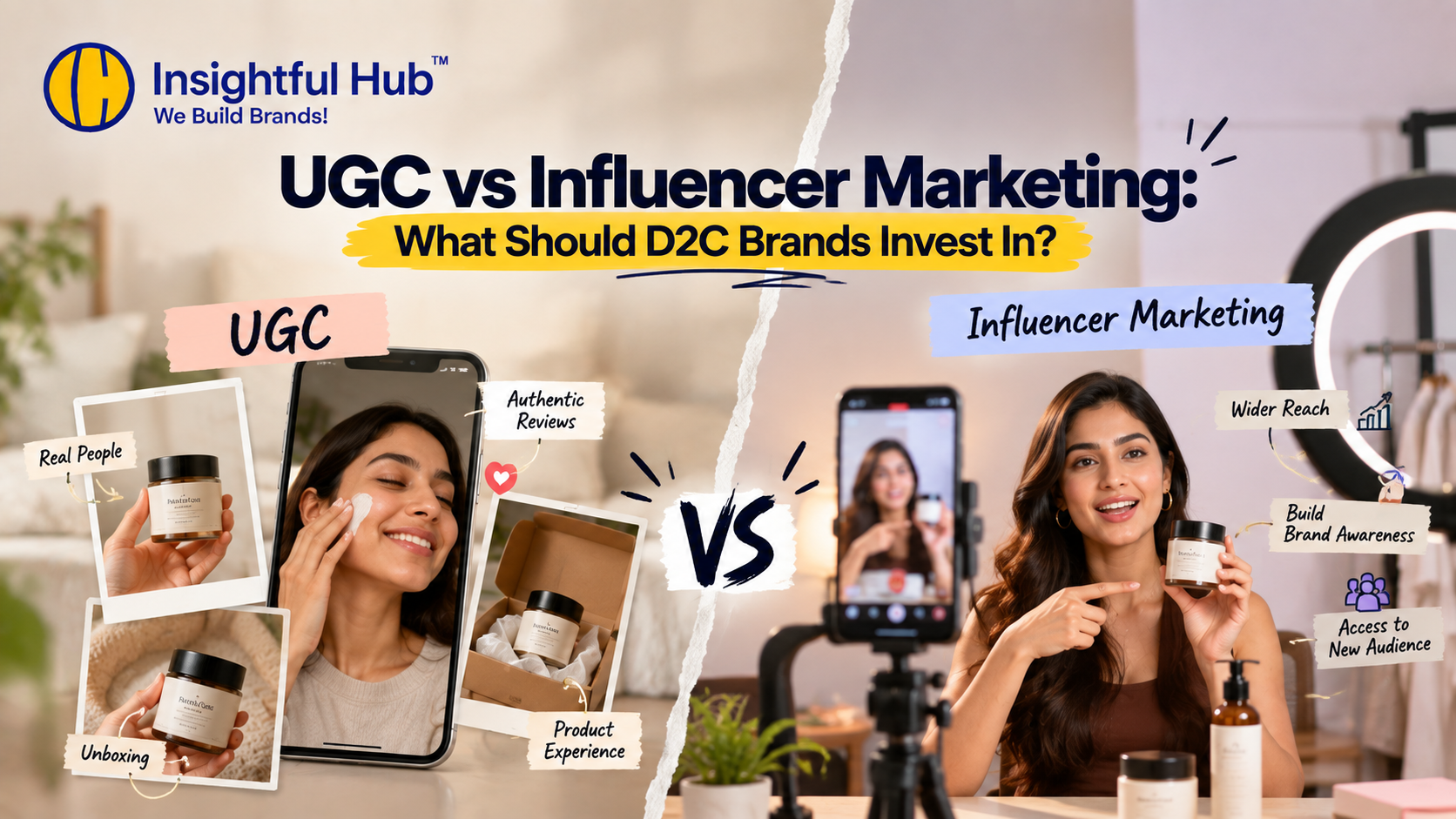
UGC vs Influencer Marketing: What Should D2C Brands Invest In?
For D2C brands, getting customers to notice a product is only the beginning. The bigger challenge is building trust and convincing people to buy.
Two strategies that have become increasingly important for D2C brands are User-Generated Content (UGC) and Influencer Marketing.
Although they are often used together, they serve different purposes. UGC can make a brand feel authentic and relatable, while influencer marketing can help a product reach an established audience.
So, what should your D2C brand invest in?
The answer depends on your marketing objective, target audience, product, and budget.
UGC vs Influencer Marketing: What’s the Difference?
Before deciding where to invest, it’s important to understand the difference.
UGC is content created by customers, creators, or content producers that demonstrates or talks about a product in an authentic, user-focused style.
Influencer Marketing involves partnering with a creator or influencer who promotes your product to their existing audience.
In simple terms:
UGC = Content you can use to market your product
Influencer Marketing = Access to someone else’s audience
Both can be valuable, but they work differently.
1. UGC Helps Make Your Brand Feel Authentic
Customers often want to see how a product looks or works in real-life situations before purchasing.
UGC can show:
- Real product experiences
- Product demonstrations
- Unboxing videos
- Before-and-after experiences where appropriate
- Tutorials
- Customer testimonials
- Lifestyle content
- Product reviews
Unlike traditional advertisements, good UGC can feel more natural and relatable.
For D2C brands, this content can be particularly useful across Instagram Reels, product pages, paid ads, and social media.
Keyword Focus:
- UGC marketing for D2C brands
- user generated content marketing
- D2C content marketing
- UGC agency
2. Influencer Marketing Helps You Reach New Audiences
Influencer marketing focuses on leveraging an existing creator audience.
Instead of building an audience from scratch, brands collaborate with creators whose followers may already be interested in a particular category.
Influencers can help brands with:
- Product awareness
- New audience discovery
- Social proof
- Product launches
- Campaign reach
- Brand credibility
- Community engagement
For example, a skincare brand might collaborate with beauty creators, while a fitness brand may work with fitness-focused creators.
The key is choosing creators whose audience is relevant to your product, rather than selecting someone purely because they have a large follower count.

3. UGC Can Strengthen Your Paid Advertising
One of the biggest advantages of UGC is that the content doesn’t necessarily have to remain on your organic social media channels.
Brands can also use suitable creator-made content in their advertising campaigns.
For example:
Creator video → Organic content → Paid ad → Product page → Purchase
Different creative formats can then be tested to understand which messages and content styles generate better engagement and conversions.
This makes UGC useful beyond simply building an Instagram feed.
Keyword Focus:
- UGC ads
- UGC paid advertising
- D2C performance marketing
- ecommerce advertising strategy
4. Influencer Marketing Can Create Immediate Exposure
Influencer campaigns can give a product exposure to an established audience.
However, reach alone shouldn’t be the only metric you evaluate.
Before working with an influencer, consider:
- Audience relevance
- Engagement quality
- Content quality
- Audience location
- Previous brand collaborations
- Audience demographics
- Campaign objectives
A smaller creator with a highly relevant audience may be more useful for a particular campaign than a large creator whose audience has little connection to your product.
5. UGC vs Influencer Marketing: Which Is Better?
There isn’t one option that is automatically better for every D2C brand.
| Factor | UGC | Influencer Marketing |
|---|---|---|
| Main Purpose | Create authentic content | Reach an existing audience |
| Audience Reach | Depends on distribution | Comes from creator audience |
| Content Usage | Social, website, ads | Usually creator’s channels |
| Product Demonstration | Strong | Strong |
| Brand Awareness | Moderate | Strong |
| Paid Ads | Highly useful | Can be repurposed where permitted |
| Social Proof | Strong | Strong |
| Budget Flexibility | Often flexible | Varies significantly |
| Best For | Content + conversion | Reach + awareness |
The right choice depends on what you are trying to achieve.
6. What Should New D2C Brands Invest In?
If you’re a new D2C brand with a limited budget, building a library of quality UGC can be a practical starting point.
You can use the content across:
- Product pages
- Meta Ads
- Email campaigns
- Landing pages
Once you have strong creative assets, influencer collaborations can help you expand your reach.
A possible approach is:
UGC → Test Content → Identify Winning Creatives → Run Paid Ads → Add Influencer Campaigns
This allows the brand to learn which content styles resonate with its target customers.
7. Established D2C Brands Can Combine Both
You don’t necessarily have to choose between UGC and influencer marketing.
A strong D2C content strategy can use both.
For example:
Influencer Campaign
↓
Reach a new audience
↓
UGC Content
↓
Build product understanding and trust
↓
Paid Advertising
↓
Drive traffic
↓
Product Page
↓
Convert visitors
↓
Email / WhatsApp
↓
Encourage repeat purchases
This creates a connected content and acquisition strategy rather than treating each marketing activity separately.
How D2C Brands Can Get Better Results
Choose Creators Based on Relevance
Don’t select creators only because they have a large following.
Look at whether their audience matches your ideal customer.
Create Multiple Content Variations
Instead of producing one UGC video, test different:
- Hooks
- Product benefits
- Video formats
- CTAs
- Storylines
Repurpose High-Performing Content
A successful piece of content can potentially be used across your website, social media, advertising, and other marketing channels, subject to the creator’s usage rights.
Measure Business Results
Don’t measure campaigns only through views and likes.
Track:
- Website traffic
- Engagement
- Add-to-cart rate
- Conversion rate
- Customer acquisition cost
- Revenue
- Return on ad spend
The Future of UGC and Influencer Marketing
D2C brands are increasingly moving toward creator-led marketing and authentic brand storytelling.
Future-focused brands will likely place greater emphasis on:
- Short-form video
- Micro and niche creators
- Authentic product demonstrations
- Creator partnerships
- UGC-driven advertising
- Personalized content
- Performance-based measurement
- Long-term creator relationships
The focus is shifting from simply getting a large number of views to creating content that captures attention, builds trust, and contributes to business results.
Final Thoughts
UGC and influencer marketing aren’t necessarily competing strategies.
They solve different problems.
UGC helps brands create authentic, reusable content.
Influencer marketing helps brands reach established communities.
For many D2C brands, the strongest approach may be to use both strategically.
A simple framework is:
UGC → Build Content
Influencers → Build Reach
Paid Ads → Scale What Works
Retention → Build Long-Term Value
Instead of asking “UGC or influencer marketing?”, D2C brands should ask:
“Which combination will help us reach the right customers, build trust, and generate measurable growth?”