
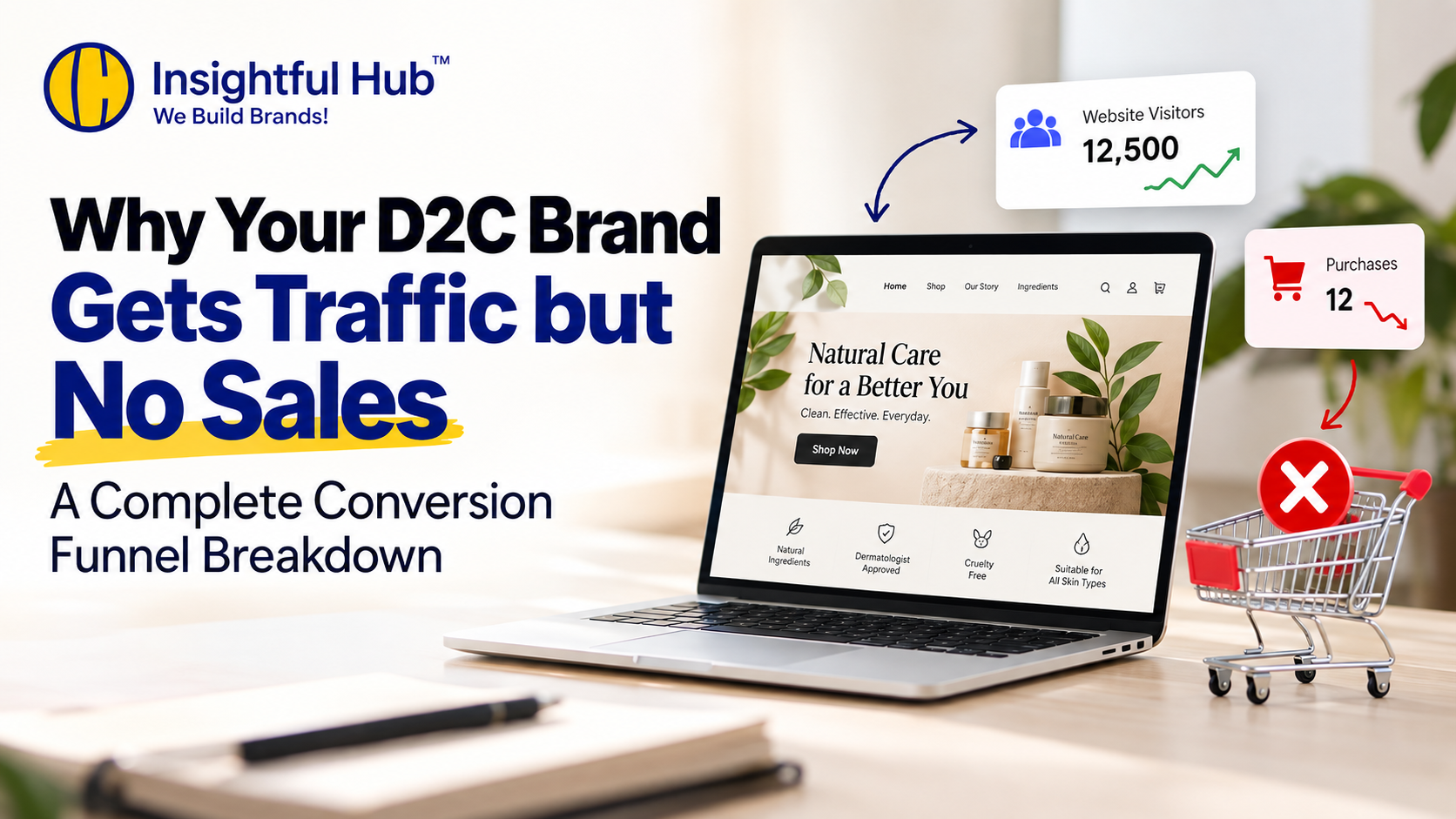
Why Your D2C Brand Gets Traffic but No Sales — And How to Fix Your Conversion Funnel
Getting traffic to your D2C website is a positive sign, but traffic alone doesn’t generate revenue.
Many D2C brands invest heavily in Meta Ads, Google Ads, influencer marketing, and SEO, yet struggle to convert visitors into paying customers.
The problem is often not the amount of traffic — it’s what happens after visitors arrive on your website.
A successful D2C brand needs a well-optimized conversion funnel that guides customers from discovery to purchase and eventually to repeat orders. Brands working with a D2C marketing agency in Bangalore focus on improving every stage of this journey instead of simply increasing advertising spend.
Why Your D2C Brand Gets Traffic But No Sales
1. You’re Attracting the Wrong Audience
Getting thousands of website visitors doesn’t necessarily mean you’re reaching potential customers.
If your advertising campaigns target people who aren’t genuinely interested in your products, you’ll see clicks without meaningful conversions.
Common problems include:
Targeting audiences that are too broad
Poor ad-to-product alignment
Ignoring customer behavior
Not using retargeting
Focusing on clicks instead of purchase intent
A strong D2C marketing strategy focuses on reaching the right customer rather than simply generating more traffic.
Keyword Focus:
D2C marketing agency Bangalore
D2C marketing strategy
ecommerce marketing agency
D2C brand growth
2. Your Website Doesn’t Communicate Your Value Clearly
When visitors land on your website, they should quickly understand:
What do you sell?
Who is it for?
Why should they choose you?
If your homepage is visually attractive but doesn’t communicate your value proposition clearly, visitors may leave without exploring your products.
Your hero section should include:
A clear headline
Strong product visuals
Short supporting copy
A prominent CTA
Important trust signals
A conversion-focused ecommerce website design should make it easy for visitors to understand your brand and take the next step.
Keyword Focus:
ecommerce website design
D2C website development
ecommerce conversion optimization
D2C website design
3. Your Product Pages Aren’t Convincing Customers
Your product page is one of the most important parts of the D2C conversion funnel.
Customers may leave if they can’t find answers to basic questions about your product.
A strong product page should clearly explain:
Product benefits
Key features
Ingredients or specifications
How to use the product
Customer reviews
Shipping information
Return policy
Frequently asked questions
The goal isn’t to simply display a product.
It’s to give customers enough information and confidence to make a purchase.
Keyword Focus:
ecommerce product page optimization
D2C conversion optimization
ecommerce CRO services
product page optimization
4. Your Website Doesn’t Have Enough Trust Signals
Customers are more likely to purchase when they feel confident about a brand.
This becomes especially important for new D2C businesses that haven’t built strong brand recognition yet.
Useful trust signals include:
Customer reviews
Product ratings
Testimonials
User-generated content
Secure payment information
Clear shipping policies
Easy returns
Certifications where applicable
Customer support information
Don’t hide these elements at the bottom of the website.
Place relevant trust signals close to important buying decisions.
5. Your Checkout Process Is Too Complicated
Sometimes customers are ready to buy but abandon their carts because the checkout experience creates unnecessary friction.
Common issues include:
Unexpected shipping charges
Too many checkout fields
Limited payment options
Forced account creation
Slow checkout pages
Unclear delivery information
A simple checkout journey should look like:
Product → Cart → Checkout → Payment → Confirmation
The easier you make the process, the fewer unnecessary obstacles customers face.
Keyword Focus:
ecommerce conversion rate optimization
ecommerce checkout optimization
D2C conversion rate
ecommerce CRO
6. You’re Not Following Up With Potential Customers
Not every customer will purchase during their first visit.
Some visitors need more information, while others may simply get distracted.
This is where remarketing and abandoned-cart recovery can help.
Brands can use:
Email marketing
WhatsApp marketing
Retargeting ads
SMS campaigns
Abandoned-cart reminders
Personalized product recommendations
Instead of letting potential customers disappear, build a system that brings them back to your brand.
How D2C Brands Can Improve Their Conversion Rate
Optimize Your Landing Pages
Make sure your advertising message and landing-page content match.
If your advertisement promotes a specific product or offer, visitors should immediately find the same product or offer when they arrive on your website.
Improve Your Product Pages
Use clear product benefits, high-quality visuals, reviews, FAQs, shipping information, and strong CTAs.
Make Your Website Mobile-Friendly
A large portion of ecommerce browsing happens on smartphones.
Make sure your website has:
Fast loading times
Easy navigation
Mobile-friendly product pages
Clear CTAs
Simple checkout
Use Retargeting
Retarget visitors who viewed products, added items to their cart, or interacted with your brand but didn’t purchase.
Track Your Funnel
Don’t focus only on total website traffic.
Monitor:
Website visitors
Product views
Add-to-cart rate
Checkout rate
Conversion rate
Average order value
Repeat purchase rate
These metrics help you identify where customers are dropping out.
The Future of D2C Conversion Optimization
D2C ecommerce is becoming increasingly competitive.
Brands that succeed will focus not only on attracting customers but also on creating better experiences throughout the entire customer journey.
Future-focused D2C brands will increasingly focus on:
Personalized shopping experiences
AI-powered recommendations
First-party customer data
Short-form video commerce
Creator-led content
Conversational commerce
Customer retention
Data-driven CRO
The brands that understand their customers and continuously improve their conversion funnel will be better positioned to turn website traffic into sustainable revenue.
Final Thoughts
Getting traffic but not sales doesn’t always mean you need to spend more money on advertising.
The real problem could be somewhere inside your D2C conversion funnel.
From audience targeting and website messaging to product pages, trust signals, checkout, and retention, every stage can influence whether a visitor becomes a customer.
A successful D2C strategy isn’t simply:
More Traffic = More Sales
It’s:
Right Traffic + Strong Website + Trust + Easy Purchase + Retention = Sustainable D2C Growth
If your website is already receiving traffic but conversions remain low, analyzing and optimizing your customer journey can help you get more value from the traffic you’re already generating.